Holiday Homes, Corran, West Coast of Scotland
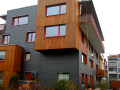
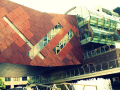
Hemcrete Projects’ low-carbon prefabricated building system, Hembuild®, is proving integral to the delivery of the first two houses of the Achabeag Township concept – a sustainable community initiative that is located on the West Coast of Scotland.
Developed by the Ardtornish Estate and Roderick James Architects, the Achabeag Township already features two homes built using the Hembuildâ wall panel system.
Commenting on the decision to use the Hembuild® system, Peter Smith of Roderick James Architects said: “Hembuild® ticks all of the boxes when it comes to delivering sustainable properties, and the system is ideally suitable for what are two totally different styled houses but which fulfil the requirements of a scheme where the use of natural materials and environmental sustainability are the order of the day.”
Developed to deliver highly sustainable and energy efficient buildings, Hembuildâ is based around a bio-composite building material made from hemp shiv (the woody core of industrial hemp) mixed with a lime-based binder – Tradical® Hemcrete®. This product, when used in conjunction with equally efficient hemp fibre insulation quilt delivers a groundbreaking combination of insulation and thermal inertia.
Building using Hembuild® creates a substantial smoothing out of temperatures, thus reducing peak loads and the capital costs of an M&E system. The building fabric partially takes over the regulation of the internal conditions using the passive properties of Hemcrete®, instead of using the active properties of the M&E system. This creates the potential for reducing capital and running costs, both of which can be modelled by Hemcrete Projects Ltd.
In addition to exceeding expectations based on conventional steady state U-values and standard thermal modelling, the process is also negative embodied carbon. This arises due to hemp capturing carbon dioxide during its rapid growth, whilst releasing oxygen back into the atmosphere. The carbon is then locked up within the walls of the building to give a carbon negative solution.